Startups rarely fail because they lack ideas.
More often, they struggle because limited resources are spread across the wrong priorities.
In an environment where capital efficiency, speed, and scalability define survival, Value Engineering (VE) offers startups a structured, evidence-based way to optimise resources while accelerating innovation — without compromising customer value.
Why Resource Optimisation Matters More Than Ever
Globally, the startup ecosystem has become more selective. While venture capital activity showed recovery in 2024 and momentum into 2025, investors increasingly expect founders to demonstrate disciplined decision-making and measurable value creation, not just growth narratives (Crunchbase, 2024; PitchBook, 2025).
This shift puts pressure on startups to:
- Avoid over-engineering early products
- Deliver faster time-to-market
- Prove capital efficiency alongside innovation
- Ensure high RoI for investment pipeline
- Fast client/ customer acquisition
This is where Value Engineering becomes highly relevant.
What Is Value Engineering (VE)?
Value Engineering is a function-oriented methodology that improves value by systematically analysing the relationship between function and cost.
> Value = Function ÷ Cost
Rather than focusing on cutting costs in isolation, VE asks a more fundamental question:
What function truly matters to the user — and what is the most efficient way to deliver it?
Standard VE practice implies:
- Focus on Value and Function Analysis
- Following structured, step-by-step Job Plans
- Creative process for identifying solutions
- Integration with domain / segment specific frameworks
- Cross-functional teamwork and deep stakeholder engagement
Why VE Is a Natural Fit for Startups
Startups operate in conditions that closely mirror ideal VE environments:
- Uncertain requirements
- Rapid iteration
- Cross-functional teams
- High cost of wrong decisions
VE supports startups by helping teams:
- Clarify must-have versus nice-to-have functions early
- Reduce feature creep before it becomes expensive
- Align engineering, product, and business priorities
- Instead of building “more,” startups can focus on building what matters most.
Quantified Benefits of Value Engineering
Global studies and applied VE case literature consistently show measurable benefits:
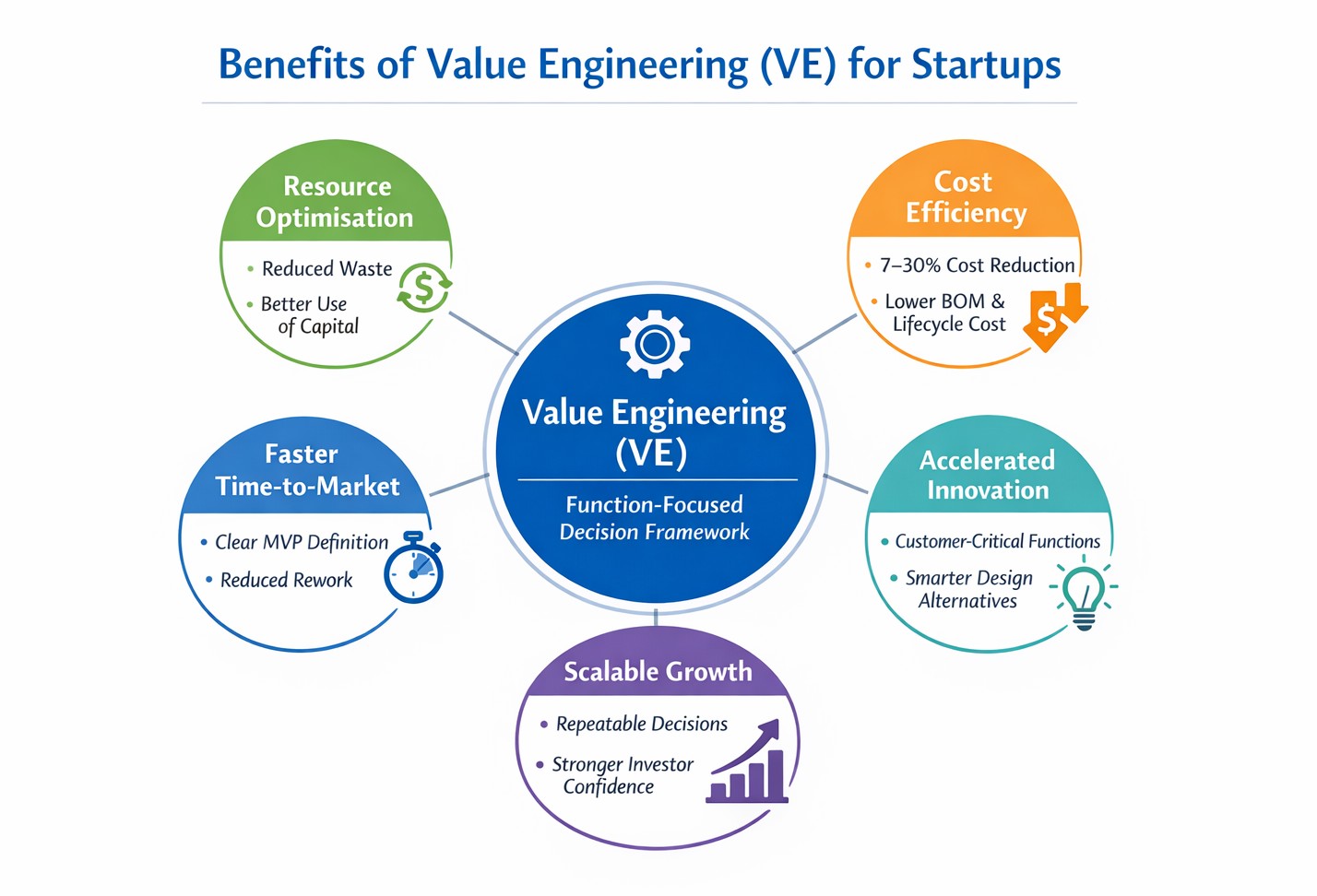
- 7–30% cost reduction across products, components, and systems
- High benefit-to-cost ratios, often several times the investment in VE facilitation
- Improved decision speed by eliminating low-value alternatives early
These outcomes have been documented across construction, manufacturing, and product development environments — many of which directly translate to startup contexts (SAVE International, 2023; Dell’Isola, 2019).
How Startups can Apply VE in Practice
- Product Cost Optimisation
By analysing product functions rather than parts alone, startups can:
Simplify product architecture
Reduce bill of materials (BOM)
Select alternative materials or processes
Applied VE studies report up to 30% cost reduction on targeted components, freeing capital for growth activities. Many organisations report payback periods of 3–12 months for VE interventions, even at small project scales (SAVE International, 2023; Dell’Isola, 2019).
- Faster Time-to-Market
VE helps teams prioritise essential customer functions, enabling:
- Leaner Minimum Viable Product (MVP) definitions
- Shorter development cycles
- Faster validation with real users
This clarity reduces rework and accelerates learning loops — critical for early-stage scaling.
- Smarter Resource Allocation
Instead of spreading limited funds across too many features, VE enables:
- Focused investment in high-value functions
- Redirection of savings to customer acquisition, pilots, or scaling
- Clear trade-off decisions supported by data
The result is intentional innovation, not accidental complexity.
Value Engineering as a Scale-Up Accelerator
As startups move from early traction to scale, complexity increases. VE provides a repeatable framework to:
- Maintain functional clarity as teams grow
- Control costs without slowing innovation
- Strengthen investor confidence through structured decision-making
For scale-ups, VE is not a one-time exercise — it becomes a governance mechanism for value-based growth.
Final Reflection
For startups, Value Engineering is not about doing less.
It’s about doing the right things first — and doing them well.
By aligning innovation with function and value, VE helps startups scale smarter, faster, and with greater confidence.