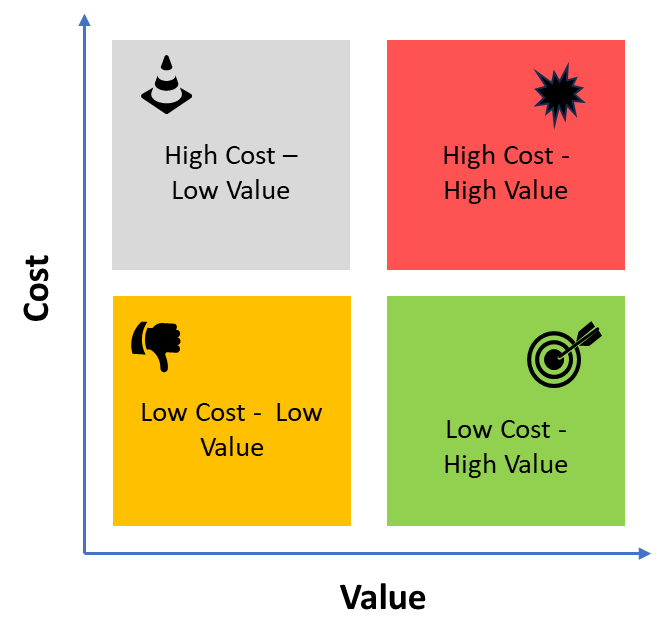
Value Engineering: A Broader, Purpose-Driven Approach
Value Engineering goes beyond cost reduction. It aims to:
- Achieve higher value at lower cost, or
- Improve function without increasing cost
VE focuses on function, performance, and stakeholder needs — not just the price tag. While cost is a factor, it’s never the sole driver.
This is why VE is not simply “cost cutting.” Instead, it is about making smarter decisions that enhance usefulness, quality, and long-term outcomes.
VE and Cost Engineering: Stronger When Used Together
Although they are different, Value Engineering and Cost Engineering can complement each other beautifully.
VE identifies opportunities where cost-related actions will not compromise quality or performance. Cost Engineering then helps execute those actions effectively.
Used together, they allow organisations to achieve:
- Short-term cost savings
- Long-term value creation
- Stronger functional performance
- Better alignment with customer needs
This synergy makes both approaches more powerful.
Why Value Engineering Has the Advantage
Value Engineering provides several benefits that extend far beyond immediate savings:
- It takes a holistic, lifecycle-based approach to optimisation.
- It aligns design, function, and cost with stakeholder expectations.
- It helps uncover innovation and improvement opportunities.
- It promotes long-term quality, not short-term cuts.
- It improves stakeholder satisfaction by enhancing the usefulness and performance of the solution.
- It fosters creativity, leading to better alternatives and new ideas.
- It nurtures a culture of continuous improvement, strengthening organisational capability over time.
Category | Value Engineering | Cost Engineering |
Definition | A systematic approach to improve the “Value” of goods or service | A field of engineering practice that involves cost estimation, cost control, cost forecasting, investment appraisal, and risk analysis. |
Primary Focus | Improving the function or performance of a product or service while reducing costs. | Managing and controlling costs |
Approach | Function-oriented approach. Examines essential functions and finds ways to achieve them at the lowest cost. | Cost-oriented approach. Involves detailed cost analysis and financial planning. |
Techniques/Tools | Analysing, Methodology, Engineering, Management. | Cost estimation, cost control, cost forecasting, earned value management (EVM), cost-benefit analysis. |
Outcome | Optimizes overall value by enhancing functionality and reducing unnecessary costs. | Ensures financial efficiency by managing and predicting project costs |
Application | Used in product development, manufacturing, construction, and service industries | Used in project management, construction, engineering, manufacturing, and industries requiring cost control. |
Conclusion: Reducing Cost Isn’t Enough — Increasing Value Is What Truly Matters
While cost matters, value matters more.
Cost Engineering helps control budgets, but Value Engineering helps build solutions that work better, last longer, and deliver more for stakeholders.
Once organisations understand this distinction, they unlock opportunities for innovation, quality enhancement, and sustainable long-term impact.